In the world of marketing and sales, the battleground is not just the shelf or the website—it is the human mind. Every day, consumers make hundreds of decisions, and contrary to popular belief, most of these decisions are not purely rational. They are influenced by shortcuts in our thinking, known as cognitive biases.
These biases are essentially mental patterns or quirks that help our brains process information quickly. While they can sometimes lead us astray, they are also powerful tools. Successful businesses study these psychological triggers to understand how do businesses use cognitive bias to their advantage? The answer lies in aligning their products, messaging, and customer experience with the way people naturally think and decide.
This article explores the fascinating intersection of psychology and commerce, revealing how companies use these mental shortcuts to build better relationships, increase sales, and create memorable brands. We will also look at what are the benefits of cognitive biases when applied ethically.
What Are Cognitive Biases in Business?
Before diving into the “how,” we must first define the landscape. What are cognitive biases in business? They are the predictable patterns of irrational behavior that customers (and even managers) exhibit.
In a business context, these biases influence everything from how a customer perceives a price to whether they trust a brand. For example, a customer might choose a mid-priced wine not because it tastes the best, but because it avoids the “too cheap” and “too expensive” extremes. This is the “Decoy Effect” at work.
Understanding these biases allows companies to design their sales funnels, websites, and pricing strategies to feel intuitive and reassuring to the customer, rather than confusing or overwhelming.
The Benefits: Can Cognitive Biases Be Good for Entrepreneurs?
There is a common misconception that cognitive biases are always negative—errors in judgment that lead to bad decisions. However, when viewed through the lens of business strategy, they are neutral tools. The ethics lie in their application.
So, can cognitive biases be good for entrepreneurs? Absolutely. When used to build trust, simplify complex choices, and create genuine value, they are incredibly beneficial.
For entrepreneurs, leveraging biases can mean the difference between a startup that struggles to explain its product and one that sells effortlessly. For instance, using the “Social Proof” bias (displaying testimonials and user numbers) helps a new company overcome the trust deficit that all young businesses face. It’s not manipulation; it’s helping potential customers feel safe making a positive decision.
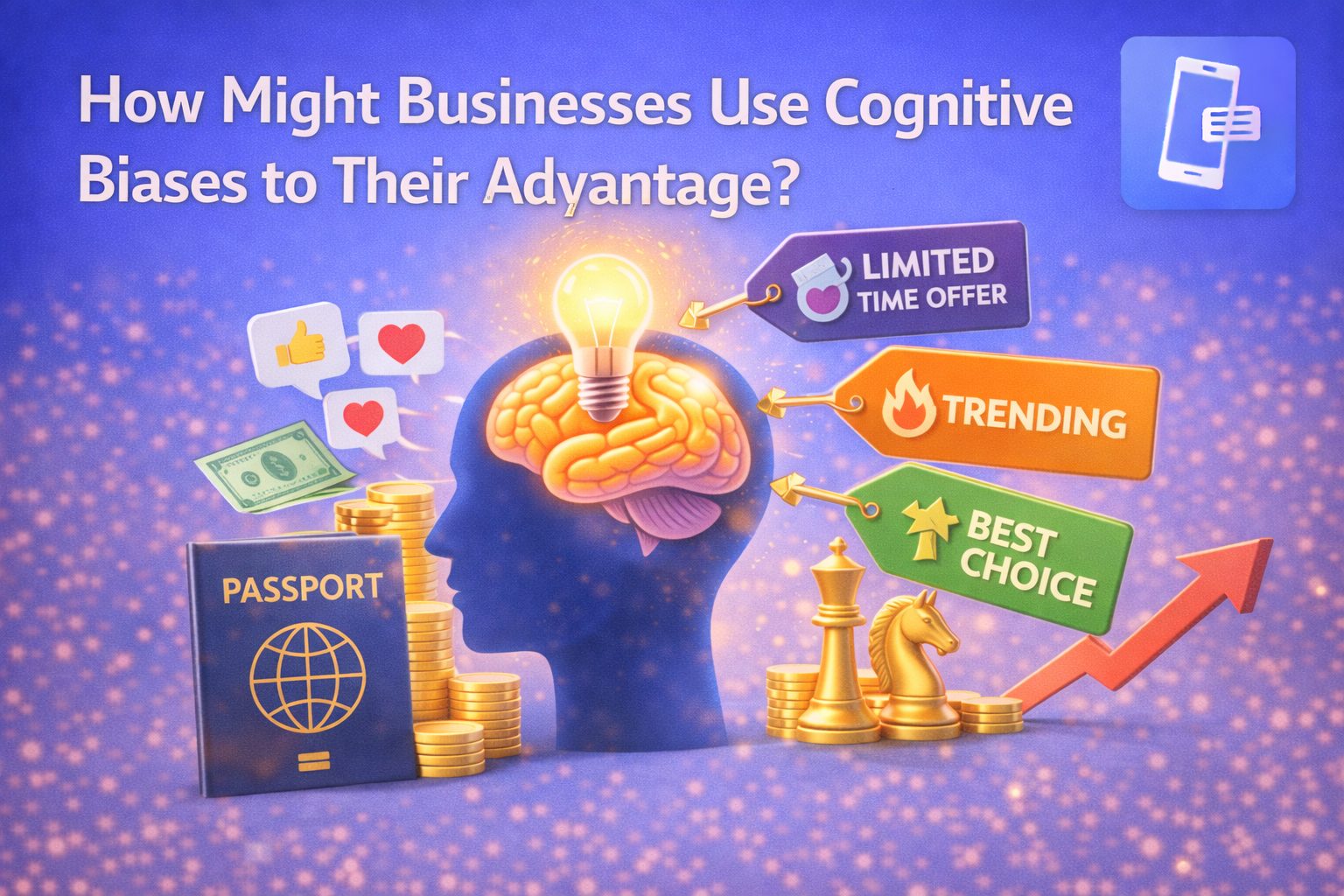
How Might Businesses Use Cognitive Biases to Their Advantage?
Now, let’s explore the practical applications. Here are some of the most common cognitive biases and exactly how might businesses use cognitive biases to their advantage in the real world.
1. The Decoy Effect: Steering Customers to the “Right” Choice
This is a classic pricing strategy. Imagine a coffee shop offering three cup sizes: Small for $2, Medium for $3.50, and Large for $3.75. The Medium size looks like a terrible deal compared to the Large. In this setup, the Medium is the “decoy.” Its only job is to make the Large look like a no-brainer bargain.
Businesses use the decoy effect to guide customers toward higher-margin items or specific subscription tiers without forcing them. By presenting an option that is clearly inferior, the preferred option becomes the obvious choice.
2. Anchoring: Setting the Perceptual Baseline
Anchoring is the human tendency to rely heavily on the first piece of information offered (the “anchor”) when making decisions. Retailers use this constantly. You might see a watch originally priced at $500, now marked down to $250. The $500 is the anchor. Even if the watch was never intended to sell for $500, that anchor makes the $250 price feel like a steal.
In B2B sales, a consultant might present a high-tier “platinum” package first. Even if the client doesn’t choose it, it anchors their perception of value, making the “gold” or “silver” packages feel more reasonable and affordable.
3. Social Proof: Following the Crowd
Humans are social animals. We look to others to determine correct behavior, especially in situations of uncertainty. This is why businesses plaster testimonials, reviews, and user count statistics everywhere.
When you see “Join 10,000+ happy customers” or a product with 4.8 stars, your brain takes a shortcut: “If all these people like it, it must be good.” This bias reduces the perceived risk of purchase. It answers the unspoken question, “Is this a safe choice?” without the business having to argue the point.
4. The Scarcity Principle: The Fear of Missing Out (FOMO)
If something is rare or limited, we want it more. This bias is rooted in our survival instinct—if resources are scarce, we need to secure them quickly. Businesses leverage this with tactics like:
- “Only 3 left in stock!”
- “Sale ends tonight!”
- “Limited edition release.”
This creates a sense of urgency. It pushes the customer from “I’ll think about it” to “I need to buy this now before it’s gone.” When combined with digital tools, this becomes even more powerful. For example, a sales representative at a trade show can instantly share a “limited time” digital offer card via their phone, tapping into scarcity immediately.
5. The Reciprocity Bias: Give and You Shall Receive
This bias is simple: if someone does something for us, we feel a psychological obligation to return the favor. This is why content marketing works so well. When a company provides a free, valuable ebook, a detailed guide, or a useful webinar, they are giving first.
The recipient, feeling indebted, is more likely to reciprocate by providing their email address, signing up for a trial, or eventually making a purchase. It’s the foundation of “freebie” marketing.
6. The Halo Effect: One Trait Shines on the Rest
The Halo Effect occurs when our overall impression of a person or brand influences how we feel about their specific traits. If a brand looks beautiful and premium (sleek website, elegant packaging), we tend to assume their customer service is great and their product is high quality.
This is why companies invest heavily in design and branding. A positive first impression creates a “halo” that colors every subsequent interaction the customer has with the business.
The Networking Connection: Building Professional Trust
While these biases are often discussed in the context of mass marketing and e-commerce, they are equally vital for B2B relationships and networking. In the world of entrepreneurs and professionals, first impressions are everything.
Consider the “Halo Effect” in a networking scenario. If you meet someone and they present themselves as organized, tech-savvy, and prepared, you assume their business acumen is equally sharp. This is where modern tools bridge the gap between psychology and practicality.
Imagine you are at a business mixer. You strike up a conversation with a potential client. Instead of fumbling for a crumpled paper card that will likely get lost, you use a digital business card. The sleek, instant transfer of your details via NFC or QR code creates a Halo Effect. It signals that you are forward-thinking, efficient, and environmentally conscious. This positive feeling transfers to the recipient’s perception of your company’s reliability. You’ve used a psychological principle (Halo Effect) and a digital tool to solidify a professional relationship instantly.
Ethical Considerations: The Fine Line
With great power comes great responsibility. Using cognitive biases crosses the line from persuasive marketing to manipulation when it exploits vulnerabilities or deceives customers.
- Manipulation: Tricking customers into buying something they don’t need or that doesn’t work.
- Persuasion (Ethical): Helping customers feel confident in choosing a product that genuinely solves their problem.
Ethical businesses use these biases to remove friction, build trust, and highlight value—not to trap consumers. The goal should always be a win-win situation where the customer feels good about their purchase.
Summary: The Strategic Advantage of Understanding the Mind
Understanding what are the benefits of cognitive biases allows businesses to communicate more effectively. Instead of shouting “Buy now!” into the void, they can create environments where buying feels like a natural, logical, and safe decision.
From the Decoy Effect in pricing to Social Proof in reviews, and from Scarcity in sales to the Halo Effect in branding, these mental shortcuts are the hidden drivers of consumer behavior. For entrepreneurs, mastering these concepts is not about being tricky; it’s about being human-centric.
As you build your business, remember that every interaction is a psychological one. Whether you are designing a website, setting a price, or simply handing over your contact information via a digital business card, you are engaging with the cognitive biases that shape human connection. Use that knowledge wisely, and you will build not just a customer base, but a loyal community.