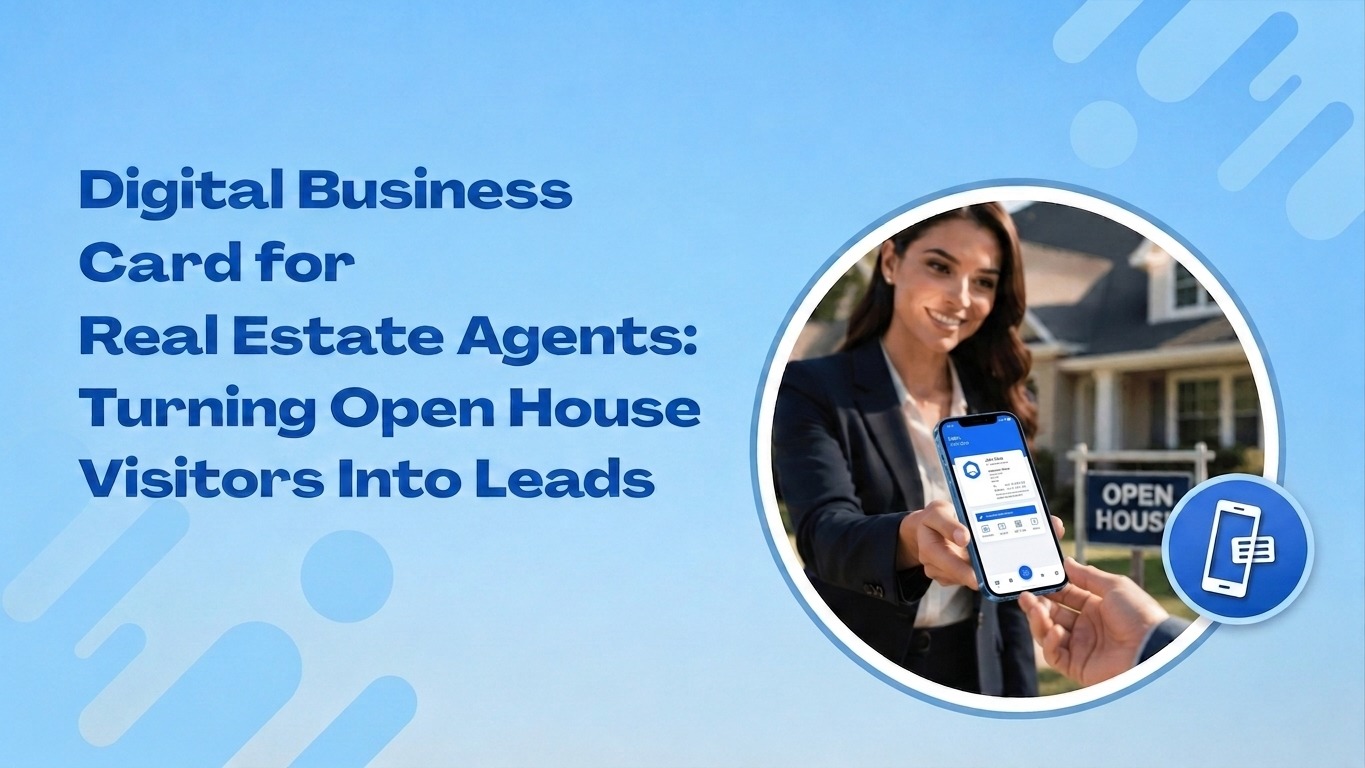
A digital business card for real estate agents solves the exact moment that costs agents the most deals: the open house visitor who walks out with your name half-remembered and no way for you to follow up. Instead of a stack of paper cards that ends up in a coat pocket, a digital card puts your listings, your contact details, and a way to capture the visitor’s information in a single scan.
Why Paper Still Fails Agents in 2026
Real estate runs on speed to lead. A buyer who tours a home on Saturday is often talking to a second agent by Sunday if the first one does not follow up fast. Paper cards work against that speed. They get lost in a bag, they show an old brokerage name after a move, and they give you no way to know who actually kept your information versus who tossed it in the parking lot. An agent going through fifty open house visitors a month is printing and reprinting constantly and still ending most conversations with no reliable way to reconnect.
What Changes With a Digital Card
A digital business card replaces that paper stack with one link or QR code that opens a mobile profile in the visitor’s browser, no app required. The visitor sees your photo, your contact details, your active listings, and a way to save your information in one tap. When you change brokerages or update a listing, everyone who has ever scanned your card sees the new version instantly. Nothing needs reprinting, and nothing goes out of date in someone’s wallet.
Setting Up Open House Lead Capture
Open house lead capture is where a digital card earns its place in an agent’s toolkit. Instead of a sign-in sheet with illegible handwriting, place your QR code on a table tent or the front door. Visitors scan it, land on your profile, and a short form asks for their name, email, and phone number before they see the full listing details. That form turns a walk-through into a tracked lead the moment it happens, rather than a name you try to decipher from a clipboard on Monday morning.
Real Estate QR Code Business Card Placement
A real estate QR code business card only works if people actually see it and scan it. Print your code on yard signs, window flyers, and postcards so it travels with every piece of marketing tied to a listing. Set your phone brightness to maximum for dim indoor showings, and keep a backup QR code printed on a small card in your folder in case a phone is dead or offline. The goal is that a prospect never has to ask for your details manually; they simply scan and move on.
Linking Property Listings Directly to Your Card
Every card should link straight to your active listings rather than a generic website homepage. Add a direct link to the MLS listing, a virtual tour, and a mortgage calculator if you have one available. When a buyer walks out of an open house and later shares your card link with a partner or family member, that person should be able to revisit the exact property without hunting through your website. If you want to set this up for your own listings, you can create a free digital business card and add your listing links directly to your profile in a few minutes.
Realtor Digital Business Card App Habits That Convert
A realtor digital business card app only helps if you build it into your daily routine rather than pulling it out occasionally. Keep your QR code saved on your phone’s lock screen so you are never digging through apps mid-conversation. Update your card the moment a listing goes under contract, since nothing looks worse than a prospect discovering the home they wanted is already sold. Review your card monthly to confirm every link still points somewhere active and current.
Following Up Before the Lead Goes Cold
Speed matters more in real estate than in almost any other field. A lead captured through your open house form should get a follow-up message within hours, not days. Sync your card to whatever CRM or spreadsheet you already use so captured contacts land somewhere you actually check, rather than sitting unread in a separate dashboard. Agents who follow up the same day consistently close more of these leads than agents who wait until the next open house to catch up on the last one.
Team and Brokerage Considerations
For brokerages managing multiple agents, a shared card platform keeps branding consistent across the team rather than leaving each agent to design something different. A manager can see which agents share their cards regularly and which open houses generate the strongest engagement, which helps decide where to focus marketing spend next quarter. For a deeper look at measuring this kind of performance, our guide on how to track networking ROI with a digital business card breaks down which metrics matter and how to calculate a realistic return.
Getting Started as a Solo Agent
You do not need a brokerage rollout to benefit from this. A single agent can set up a card in minutes, add active listings, and start using it at the next showing. Test the QR code on both an iPhone and an Android device before your first open house, since a code that fails to scan defeats the purpose. Once it works reliably, sharing it becomes automatic within a week or two.
Final Thoughts
Real estate is a relationship business measured in commissions, and a lost contact is a lost deal someone else closes instead. A digital business card for real estate agents removes the biggest weakness of paper cards: the gap between a good conversation and an actual follow-up. Between QR codes on yard signs, direct listing links, and an open house form that captures a lead automatically, the agents adopting this now are closing deals that used to slip through a forgotten paper card.

![Read more about the article Top Free E-Card Templates for [Holiday/Occasion] in 2026- 2027](https://www.shareecard.com/weblog/wp-content/uploads/2026/09/image-300x169.png)