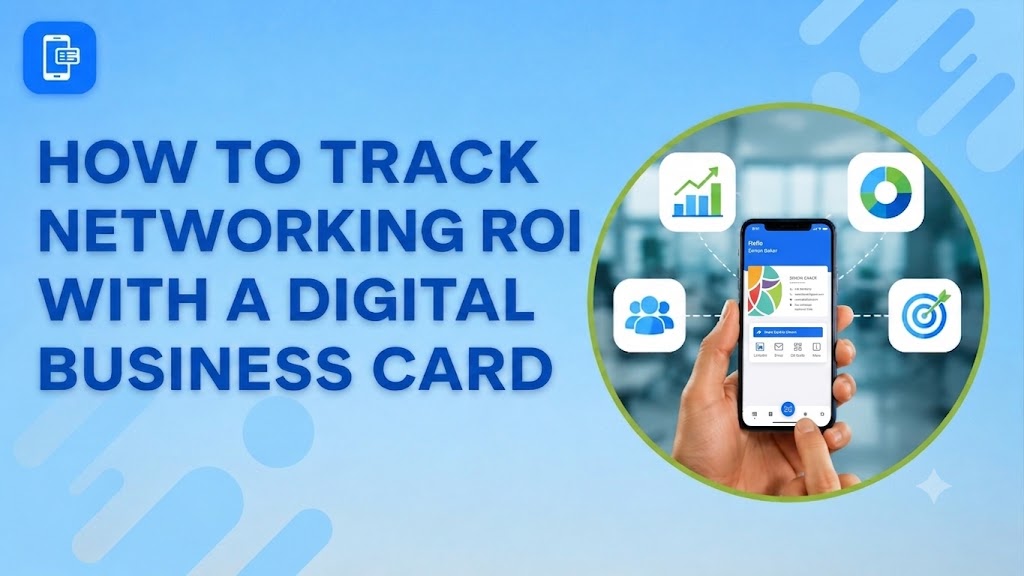
Most professionals hand out their contact details at events and never know what happens next. Did that person visit the website? Did they call? Did they even save the number? Paper cards offer zero answers. A digital business card changes this entirely because every interaction it generates leaves a measurable trail. If you are serious about understanding which networking efforts actually produce results, knowing how to measure networking ROI and track networking ROI with a digital business card is one of the most practical skills you can build in 2026.
Why ROI Tracking Matters More Than Ever
Networking is a real business investment. It costs time, travel, event fees, and energy. Without data, you are spending all of it on instinct alone. A study by Forbes found that companies digitizing their business processes reduce operational time by up to 30 percent. Digital business card analytics bring that same principle to networking. Instead of guessing whether a conference was worth attending, you see the numbers and let them decide for you.
The digital business card market is growing at 12.2 percent CAGR in 2026 and professionals are not adopting these tools just for convenience. They are adopting them because a smart card gives back data that a paper card never could.
What Digital Business Card Analytics Actually Track
A strong digital business card platform tracks far more than basic view counts. Understanding the digital business card metrics to track is the first step toward turning every event into measurable data rather than guesswork.
Card views show how many people opened your profile after you shared it. This is your reach, the first signal of whether your card is being seen at all. A high view count from a specific event tells you that event was worth attending from a pure awareness standpoint.
Contact saves track how many people actually saved your details to their phone or contacts app. This metric sits one step deeper than a view and tells you how many people considered you relevant enough to keep. A good follow-up rate starts here.
Link clicks reveal which parts of your profile generate real interest. If your portfolio link gets clicked twenty times but your LinkedIn gets clicked twice, you know exactly what your audience wants to see more of. Digital business card engagement tracking at this level shapes your content strategy rather than just your networking strategy and tells you exactly where to invest more effort.
QR scan location data shows where your card is being shared geographically. If you attend events across multiple cities, this tells you which region produces the most engaged contacts. ShareEcard provides this kind of location based visibility in its analytics dashboard, which helps teams understand which markets respond best to their outreach.
CRM contact captures are the metric closest to a direct conversion. When someone fills in their details through your digital business card and lands in your CRM automatically, that is a tracked lead with a known origin. You can follow that lead all the way to a closed deal and trace the revenue directly back to the networking event where the card was shared.
How to Calculate Your Networking ROI
Calculating digital business card ROI is more straightforward than most people expect. Take the total value of the business generated through your tracked contacts and subtract the cost of the events, subscriptions, and time involved. Divide that result by your total investment and multiply by one hundred to get a percentage.
A realistic example makes this concrete. Say you attend three events in a quarter and your digital business card records 400 total views across those events with 80 contact saves and 12 leads captured. Of those 12 leads, 3 convert into paying clients worth a combined two thousand dollars. If your total networking cost for that quarter was five hundred dollars, your ROI is three hundred percent. Without digital business card analytics, you would never know which of those events produced those three clients or whether any of it was worth the investment at all.
Setting Up Your Tracking System Before the Next Event
Tracking ROI does not happen automatically without a small amount of preparation. Before your next networking event, make sure your digital business card includes UTM links on any URLs pointing to your website. This lets Google Analytics or your CRM attribute website visits directly to your card rather than lumping them into a general traffic category.
Connect your digital card platform to your CRM if the tool supports it. ShareEcard integrates with popular platforms so contact captures flow directly into your pipeline without manual entry. This removes the single biggest gap in most networking workflows, which is the delay between meeting someone and actually following up with them.
Set a clear time frame for measuring results. Most networking conversions do not happen the same day. A thirty day window after an event is a reasonable benchmark for measuring how many initial contacts turned into real conversations and how many real conversations turned into opportunities.
What a Good Follow-Up Rate Looks Like
Industry benchmarks suggest a strong follow-up rate after a networking event sits between 20 and 40 percent of contact saves. If you share your card with 50 people and 10 of them reach out or respond to your follow-up, you are performing at the upper end of what most professionals achieve. If your rate consistently falls below 10 percent, the digital business card metrics to track next are profile completeness and audience fit, since weak results usually point to one of those two gaps. Either your card profile needs work or you are networking in front of the wrong audience entirely.
Why ShareEcard Gives You a Real Measurement Advantage
Most professionals are still guessing about their networking results. ShareEcard is built specifically so you do not have to. Its built-in analytics dashboard lets you track networking ROI with a digital business card through real-time views, contact saves, link clicks, and geographic engagement data, all in one place without needing a separate tool for each metric.
You can compare performance across events, identify your highest performing card if you manage multiple profiles, and export data for reporting to a team or manager. For sales professionals, recruiters, and business development teams, this level of visibility turns networking from an instinct-driven activity into a measurable growth channel.
FAQs
How do you measure the ROI of a digital business card?
You compare the revenue generated through tracked contacts against the total cost of networking events and tools, using card analytics data to connect the original interaction to the final outcome.
What metrics should you track for networking ROI?
The most important digital business card metrics to track are card views, contact saves, link clicks, QR scan locations, and CRM lead captures. Knowing how to measure networking ROI means connecting each of these data points back to a real business outcome rather than treating them as vanity numbers.
Can digital business cards show who viewed them?
Most platforms show aggregate view data rather than individual viewer identities, though some tools surface contact details when someone actively saves your information or fills in a contact form.
What is a good follow-up rate after a networking event?
A follow-up rate between 20 and 40 percent of contact saves is considered strong, though anything above 10 percent suggests your card and your networking audience are reasonably well matched.