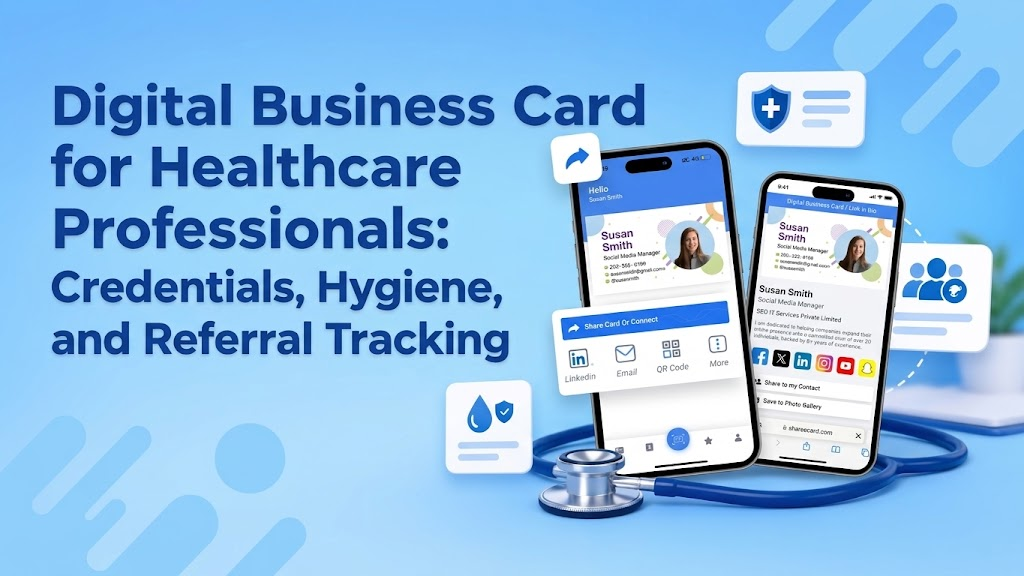
A digital business card for healthcare professionals solves three problems paper cards create in a clinical setting: they cannot be sanitized between patients, they go out of date the moment a credential or affiliation changes, and they give no way to track whether a referral or introduction actually led anywhere. This guide covers what to include on a medical professional’s card and how to use it across conferences, referrals, and daily patient interactions.
Why Paper Cards Create Real Problems in Healthcare
A physical business card is a surface that passes between hands, pockets, and desks, which is a genuine concern in any clinical environment focused on infection control. Beyond hygiene, paper cards cannot reflect a change that happens often in medicine: a new board certification, a change in hospital affiliation, or an updated office location. Every reprint costs time and money, and every card already in circulation before that change becomes outdated the moment it happens.
What to Include on a Healthcare Professional’s Card
A digital business card for doctors should lead with full name and credentials, using clear post-nominal letters such as MD, DO, RN, NP, PA-C, or DDS, since these are the trust signals patients and referring colleagues look for immediately. List your specialty and department prominently, since a recipient should know at a glance whether you practice cardiology, family medicine, or pediatric nursing without reading through a full biography first. Add your practice or hospital affiliation with the relevant logo, which reinforces credibility for anyone unfamiliar with you personally.
Keeping Credentials Current Without Reprinting
One of the clearest advantages for medical professionals is that a digital card reflects a new certification, a completed fellowship, or a practice move the moment it happens, with zero lag and no reprint cost. For a profession where continuing education and credentialing happen constantly, this alone removes a recurring administrative task that paper cards make unavoidable. New residents, fellows, and staff can also receive a branded card on their first day rather than waiting on a print order to arrive.
Hygiene Considerations in Clinical Settings
A digital business card for nurses and other frontline clinical staff addresses a hygiene concern paper simply cannot solve: a card shared by tap, QR code, or link never needs to physically change hands or touch a surface that later needs sanitizing. In hospitals, clinics, and any setting where infection control matters, removing a shared physical object from the introduction process is a small but meaningful improvement over handing across a paper card.
Managing Referral Relationships
Referral tracking matters more in healthcare than in most other fields, since a referring physician’s ability to follow up with a specialist directly affects patient care continuity. A medical professional networking card that includes a direct booking or scheduling link lets a referring colleague send a patient straight to an appointment slot rather than relying on a phone call during business hours. This reduces the friction between a referral being made and a patient actually being seen.
Setting Up Your Own Card
To create a free digital business card suited to a healthcare setting, start with your name, credentials, specialty, and hospital or practice affiliation, then add a direct link to your booking system or patient portal if one is available. Keep the design clean and professional, avoiding decorative elements that could distract from the credential and contact information a patient or colleague actually needs to find quickly.
Conferences and Continuing Education Events
At medical conferences and continuing education events, healthcare professionals exchange contact information constantly, often faster than a printed card exchange allows between sessions. A digital card shared by QR code or link lets you capture a colleague’s details just as easily as sharing your own, without either party fumbling through a stack of cards between talks. This matters particularly at larger conferences where you might meet dozens of relevant contacts across two or three days.
Tracking What Actually Comes From Networking
Unlike a paper card, a digital profile can show whether a contact actually saved your details, clicked through to your booking link, or visited your profile after an initial introduction. For practice managers and administrators overseeing multiple providers, this kind of visibility helps identify which conferences or outreach efforts are actually generating new patient relationships or referral partnerships. Our guide on how to track networking ROI with a digital business card covers the specific metrics worth watching, which apply directly to measuring referral and conference activity across a healthcare team.
Rolling This Out Across a Practice or Department
For hospitals and larger practices, consistency across staff cards matters for brand recognition and patient trust. A shared platform lets administrators maintain consistent branding, logos, and formatting across every provider’s card, rather than leaving each physician or nurse to design something different on their own. New hires can be brought online with a properly branded card from their first day, without waiting on a print order or manual setup for each person individually.
Final Thoughts
Healthcare professionals face a specific set of networking challenges that paper cards were never designed to handle: constant credential changes, hygiene concerns in clinical spaces, and the need for a clear path to booking or referral follow-up. A digital business card for healthcare professionals addresses each of these directly, keeping information current, removing a shared physical surface from the introduction process, and giving both individual providers and practice administrators visibility into whether their networking efforts actually lead to appointments and referrals.